Wednesday, February 8, 2012

Bibliography


Works Cited
“Chen Boda.” Wikipedia. N.p., n.d. Web. 8 Feb. 2012. <http://en.wikipedia.org/‌wiki/‌Chen_Boda>.
“Cultural Revolution.” Cultural Revolution. N.p., n.d. Web. 8 Feb. 2012. <http://members.fortunecity.com/‌stalinmao/‌China/‌Cultural/‌Cultural.html>.
“Cultural Revolution.” Serve the People. N.p., n.d. Web. 8 Feb. 2012. <http://www.wellesley.edu/‌Polisci/‌wj/‌China1972/‌main.html>.
“Cultural Revolution.” Wikipedia. N.p., n.d. Web. 8 Feb. 2012. <http://en.wikipedia.org/‌wiki/‌Cultural_Revolution>.
Ebrey, Patricia Buckley. “Cultural revolution.” A Visual Sourcebook of Chinese Civilization   . Patricia Buckley Ebrey, n.d. Web. 1 Feb. 2012. <http://depts.washington.edu/‌chinaciv/‌graph/‌9wenge.htm>.
Hays, Jeffrey. “CULTURAL REVOLUTION--THE END, WORKING IN THE COUTRYSIDE AND LEGACY.” Global Top. N.p., Feb. 2011. Web. 7 Feb. 2012. <http://factsanddetails.com/‌china.php?itemid=66#161>.
Jing, Bian. “Mrs Jiang Qing.” Find a Grave. N.p., 10 Apr. 2010. Web. 6 Feb. 2012. <http:///www.findagrave.com/‌cgi-bin/‌fg.cgi?page=gr&GRid=50897770>.
“Michigan university rediscovers ‘Cultural Revolution’ papercuts.” The China Post. N.p., n.d. Web. 8 Feb. 2012. <http://www.chinapost.com.tw/‌art/‌arts/‌2011/‌11/‌08/‌322257/‌Michigan-university.htm>.
Mike. “History of China: Qing Dynasty Introductions.” History of China. N.p., 2007. Web. 1 Feb. 2012. <http://www.history-of-china.com/‌qing-dynasty/>.
“Political vs Philosophical Art.” Beatus. N.p., n.d. Web. 8 Feb. 2012. <http://beatusest.blogspot.com/‌2011/‌09/‌political-vs-philosophical-art.html>.
San Jose State University. “The Great Proletarian Cultural Revolution in China, 1966-1976 .” San José State University Department of Economics. N.p., n.d. Web. 8 Feb. 2012. <http://www.sjsu.edu/‌faculty/‌watkins/‌cultrev.htm>.
Wheeler, Tony, and Maureen Wheeler. “Map of China.” Lonely Planet. BBC Worlwide, 2011. Web. 1 Feb. 2012. <www.google.com/‌imgres?um=1&hl=en&safe=active&biw=1152&bih=726&tbm=isch&tbnid=mgiPpW7lTcc3jM:&imgrefurl=http://www.lonelyplanet.com/‌maps/‌asia/‌china/‌&docid=uKOgNVkGQVMBwM&imgurl=http://www.lonelyplanet.com/‌maps/‌asia/‌china/‌map_of_china.jpg&w=466&h=350&ei=64UpT_kg6brbBY75-NMC&zoom=1&iact=hc&vpx=123&vpy=167&dur=175&hovh=194&hovw=259&tx=130&ty=43&sig=104618295780292193543&page=1&tbnh=169&tbnw=225&start=0&ndsp=15&ved=1t:429,r:0,s:0>.
“The worship of Mao Zedong’s personality.” The worship of Mao Zedong’s personality. N.p., n.d. Web. 8 Feb. 2012. <http://www.lesdeuxvoyageurs.com/‌Site-Internet_Anglais/‌Articles/‌MaoImages/‌MaoImages_article.html>.

News Story


Mao Zedong is trying to create equality throughout all of China. He wants for the people in the countryside to feel equal to the people who are living in the center of the city life. How he conquers this great mission is a big controversy right now. He has started a movement called the “Down to the Countryside Movement.” He is trying to send youth away to the countryside to observe the lives of the peasants and other country folk in the China region. He is hoping that these children will be able to come back to their own hometown and share everything that is happening in the lives of the peasants. Young adults from the inner city are going to rural China to stay with and follow the peasants and other farm people to live the lives that they are living. This is starting in the early 1960s and has now really began to take off. This is happening to fulfill the dreams of Mao Zedong.
The reason that this whole movement began in the first place was so that Mao could continue to create equality. He wanted everyone to feel equal and be equal. He thought that before he could accomplish this, he had to make the people in rural China feel equal with the people who were in the middle of the action in the big cities.
Jun Shan is a 14 year old young man who was sent away to be apart of the Down to the Countryside Movement. He lives in Hong Kong and is in the eighth grade. He described how he enjoyed being a part of the movement because he knew that it was pleasing to Chairman Mao. “The only reason that I went with the movement was so that I would please my family and my master, Chairman Mao.”However, it was hard for him to be away from his family for such a long period of time. He said that he learned a lot from the family that he was observing and the daily life that they go through. He explained how different the two families lives were.
Jinghua is a 15 year old young lady who was forcefully sent away. She did not want to follow through with the Down to the Countryside Movement, but her parents wanted her to so that she would please Chairmen Mao. She tried to make the best out of her situation, but did not want to displease her parents and Mao. “As much as I wanted to please Chairman Mao, I was really dreading leaving my family and friends.” This shows how some people did not want to do as the country wanted them to do, but followed through anyways to please their great leader Chairmen Mao Zedong.

Editorial - Lost Generation


         In the early 1960's, Mao Zedong started another campaign called the Down to The Countryside Movement. This made youth go and live with a peasant family and observe and learn from their daily life. They were practicaly kicked out of their homes, and family, and forced to adapt to living with complete strangers in a complete different part of the country. These people lived completely different lives from the youth that were sent to live with them. Many teens did this to please not only their families, but their beloved Chairman Mao. Mao is extremely wrong in forcing youth to go because nobody, no matter their age should be sent away against their will, or be isolated.
            There are three reason's why this is wrong. First of all, high school students are exiled to the countryside. This means that they are sent away, without any say in where they are going. They will be apart from their family without knowing the duration of time that they will be gone, and who they are going to stay with. The second reason why this is wrong is because this group of kids is considered the "lost generation" because so many of them missed so much school. They were very uneducated whenever the Revolution ended and it was very hard for them to find work, or regain all of the schooling that they had lost. Finally, think about if you were sent to a family who was not loving, or who had very different religious and political views from you and your family. You would have to live with them until the time came for you to go home. If you were were stuck with a family that was different from you, it would be a long year.
            Some people think that what Mao is doing is the right thing because he is eliminating the three differences. The three difference are workers and peasants, urban and rural, and manual labor and mental labor. Some of the reasons that someone might think that this is right is that this did create equality for a short time. This gave the youth of the country a time to learn about what was happening in the rest of the country. However, in the end, these youth lost valuable schooling time. They lose family and friend relationships whenever they were seperated. Ultimately, they lost equality and went back to inequality.
            Every person, no matter their age, should not be sent away from their life against their will. No one should be isolated with strangers especially when you are a teenager. No matter how important you political leader is to you, this should never happen.


Art


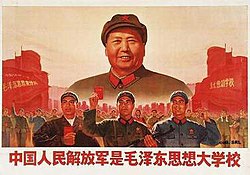
           Art was a very large part of daily life in the Cultural Revolution. Art was used as a source of propaganda. Almost everywhere that you looked, you could see a picture, poster, or statue that displayed the Cultural Revolution. The majority of posters sent some sort of message that honored Mao Zedong’s efforts to change China.Chairmen Mao, The Little Red Book, and eliminating the four olds were all main themes that continued to show themselves during the Cultural Revolution.
The art was displayed in many different ways. Their were paintings, statues, music, drawings, and sculptures. During the Cultural Revolution, this was the only form of art that was acceptable. Artists displayed their works all throughout their towns and cities. People had pictures of Mao Zedong all throughout their homes. They were required to have some sort of art that was honoring to their leader.
Most people had posters and painting’s displayed throughout their homes.Whenever your home was searched by the Red Guards, any form of art honoring Mao was one of the few things that was left untouched. This was significant because the Red Guards came to practically take all of your belongings. For them to leave anything behind, it meant that it must have been important.  
    Art was a very large part of daily life during the Cultural Revolution. Almost everywhere that you looked, you could see, hear, or touch some form of art that had something to do with the Cultural Revolution. During the Cultural Revolution, art was used as a form of propaganda that was displayed all throughout China.

Music


    Music was an enormous part of daily life during the Cultural Revolution. There were songs that people sang to honor Chairman Mao. During the Cultural Revolution, the only music that you were allowed to listen to was music that was honoring Mao Zedong and the Communist Party. Almost all of the songs said something about being red, long live Chairmen Mao, the little red book, and eliminating the four olds. Some of the most popular songs during the Cultural Revolution included The People of the World Will Surely Be Victorious!, Long Live Chairman Mao!, I Love Beijing's Tiananmen!, March of the Revolutionary Youth, and We are Chairman Mao's Red Guards.
    Music was a large part of propaganda during the Cultural Revolution because it was one way to constantly remind people about Chairmen Mao. If a song was playing, and you did not show some kind of affection for the music, you would get in trouble with the Red Guards. Many shops and stores were almost always playing music that honored the Cultural Revolution. Music would play through loudspeakers, and would be played during events, and campaigns. During this time, this was one of the main ways to show that you respect everything that is happening and changing.  You could almost always hear a song talking about how great Mao was. Music would be sung by everyday people and artists. Music was a large part of the Cultural Revolution, and was a large part of how the Cultural Revolution spread all throughout China.

Interview With Jiang Qian


Question #1: What is the most rewarding thing about being Chairman Mao’s wife?
Answer #1: The most rewarding thing about being his wife is the fact that I am a wife to such an important and amazing man. I get to be a part of his daily mission which is to eliminate the Four Olds. People worship my husband! I love that people know who I am and what is important in life. I love that so many people also admire and look up to me as well.

Question #2: What is the most challenging think about being Mao’s wife?
Answer #2: The most challenging thing is that I am almost always in the spotlight. I am being watched constantly and you are always very self conscious. It’s also hard to be known only as “Chairman Mao’s wife” and not Jiang Qing. Another challenging part is always being apart from your husband because of travel. I am the type of person who loves to be in the center of the spotlight, but then also have time to myself, and that is hard to do in my position.

Question #3: What are some of the projects that you are working on to support the Cultural Revolution?

Answer #3: The big project that I am currently working on is the Eight Model Operas. This is practically the only theatrical performance that is allowed at this time, so it is very hard to get in to. This is a great way to express all that is going on during this time. I really enjoy getting to direct and watch the plays. I love being able to be a part of such a huge production, and then to watch the final product and say that I had a part in that. I think that I am a great director and I love doing what I do.

Question #4: Do you agree with everything that is being preached in the Little Red Book?
Answer #4: I support my husband in all that he does. I think that he is 100% correct in his actions. I mean, he has completely transformed an entire country. I think that everything in the Little Red Book is exactly as it should be and I hope that it lasts for many generations to come. I am a rule follower, so almost anything that is handed to me is sure to be followed. I am somebody who loves to please everyone around me, so I follow along with the pack and do what I am suppose to do.

Question #5: Do you think that everyone should bow down to Mao or someone else? Maybe even you?
Answer #5: As much as I would love to be the center of attention, I think that everybody should worship Mao. He has worked so hard to get here. I completely support him. Anyone who doesn’t worship him should most definitely get in to serious trouble. I am a great leader, but I think that he is even better of a leader than I am. I mainly have experience in small crowds, not the entire country!

Daily Life

    I went to visit the Chang family in Shanghai, China. They are a working class family with a landlord background. This means that somebody in their family line was a landlord. Landlords are considered even worse people then criminals. Unfortunately, the families are who take the blame instead of the landlord himself. They lived in fear of being tortured by the ideas of the Cultural Revolution and their family’s past. Their house was searched very often by the red guards and many of their belongings were taken from them, only because they had a black background. Their lives were based around work, school, family, and most importantly Chairman Mao. The parents worked during the day. The mom worked at the local theatre, and the dad was a fourth grade teacher. The grandmother stayed at home and did housework while the children were at school.
The family prayed to Allah, but the main person that they publicly worshiped was Chairmen Mao. Of course this was during the Cultural Revolution, so everyone was required to love and worship Mao. Some of the things that the family did for fun was playing in the alley and going to the park. For meals, we mainly ate rice and meat. The government had many rules and were very strict. They were almost always searching houses and criticizing people’s daily lives. They were trying to eliminate the four olds. This was the most difficult part for the family because they were constantly being watched, especially because they were a landlords family.
    In the beginning of the day, the girls went to the market to get fresh food. We had breakfast as a family and then all dispersed to our normal days. The parents went to work and the kids went off to school while Grandmother stayed at home. In the middle of the day the kids got home from school and worked on their homework. The girls then did some sewing while the boys finished their chores. Then all of the children went off to play outside with their friends. At the end of the day we had a dinner of  rice and meat. Finally, we all relaxed together and then went to bed.
    For the most part, this is what the family does everyday. The main difference between their lives and our lives is that they constantly lived in worry and fear. They were constantly worried that their house would be searched again, or that they would be made fun of because of their background. Other than that, I enjoyed visiting them and getting to know how they live. Even though we think as these people as completely different people, we have very similar goals and lives. I enjoyed visiting the Chang family in Shanghai, China.